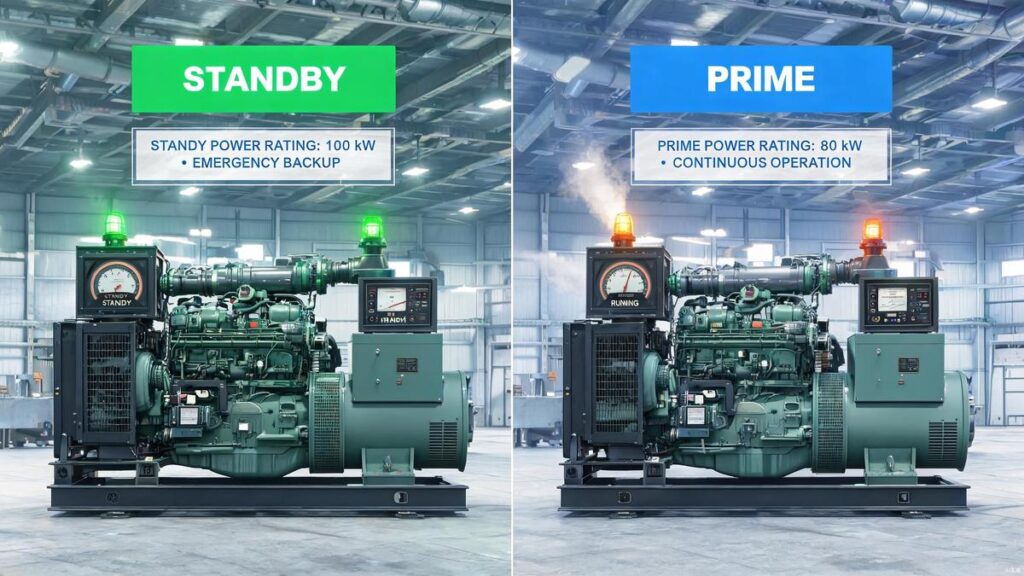
If you have ever browsed generator specifications, you have probably noticed that the same physical machine carries different power ratings depending on how it is classified. A generator rated 500 kVA standby might only deliver 450 kVA as prime power. Why the difference? And more importantly, which rating should you use for your project?
Choosing the wrong rating is not just a paperwork error — it leads to premature engine failure, voided warranties, and unexpected power shortages during critical operations. In this guide, we break down the differences between prime and standby power ratings, explain the international standards behind them, and help you select the right rating for your application.
The Three Power Ratings Explained
Diesel generator manufacturers follow ISO 8528, the international standard that defines generator set ratings based on duty cycle, load variability, and operating hours. Understanding these classifications is the first step to selecting the right generator.
Standby Power Rating (ESP — Emergency Standby Power)
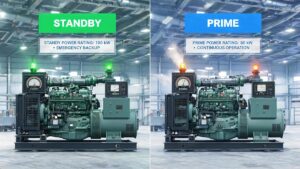
Standby rated generators are designed to provide backup power during utility outages. They operate at variable load for a limited number of hours per year — typically up to 200 hours — with no more than 25 hours of continuous operation at any single time. The generator can handle a 10% overload for 1 hour in any 12-hour period, but this is intended for emergency situations only.
Think of standby power as sprinting. The generator can deliver maximum output for short bursts, but it is not built to run indefinitely. If your facility experiences frequent or prolonged outages, a standby-rated generator will not last.
Prime Power Rating (PRP — Prime Rated Power)
Prime rated generators are built for continuous operation at variable load for an unlimited number of hours per year. However, the average load over any 24-hour period should not exceed 70% of the prime rating. The generator can deliver 10% overload for 1 hour in every 12 hours, but sustained operation above the prime rating will reduce engine life.
Prime power is like jogging — you can keep going for a long time, but not at maximum speed. Prime-rated generators have heavier-duty components, upgraded cooling systems, and more robust lubrication compared to their standby counterparts.
Continuous Power Rating (COP — Continuous Power)
Continuous rated generators are designed for non-variable, constant load operation for unlimited hours per year. They run at 100% of their rating continuously, without any overload capability. This rating is typically used in applications like grid parallel operation, base-load power generation, or co-generation plants.
Continuous power is like walking — a sustainable, steady pace that can be maintained around the clock. COP-rated generators are the most conservatively rated and the most durable.
Key Differences at a Glance
| Parameter | Standby (ESP) | Prime (PRP) | Continuous (COP) |
|---|---|---|---|
| Average load (24h) | Up to 70% of ESP rating | Up to 70% of PRP rating | 100% of COP rating |
| Annual operating hours | Up to 200 hours/year | Unlimited | Unlimited |
| Load variability | Variable | Variable | Constant (non-variable) |
| Overload capability | 10% for 1h per 12h | 10% for 1h per 12h | None |
| Max continuous run | 25 hours per event | Unlimited | Unlimited |
| Typical rating vs ESP | 100% (baseline) | ~85-90% of ESP | ~70-80% of ESP |
Why the Same Generator Has Different Ratings
This is the question that confuses most buyers. How can the same physical engine and alternator produce different power outputs? The answer lies in thermal management and mechanical stress.
When a generator runs at full load, the engine produces maximum heat. The cooling system, lubrication system, and exhaust system must all handle this thermal load. At standby rating (limited hours), the system can handle higher peak temperatures for short periods. At prime rating (unlimited hours), the same system needs more thermal headroom to prevent cumulative heat damage over thousands of operating hours.
Manufacturers achieve different ratings from the same platform by:
- Derating the fuel injection system to reduce peak cylinder pressure
- Upgrading the cooling system (larger radiator, higher-capacity water pump)
- Using heavier-duty bearings and piston rings for prime/continuous ratings
- Adjusting the alternator excitation system for different thermal limits
- Modifying the engine management software to limit sustained output
A 500 kVA standby generator and a 450 kVA prime generator may use the exact same engine block, but the prime unit has been configured and certified for more demanding duty cycles.
How to Choose the Right Rating for Your Application
When to Choose Standby Power (ESP)
Standby rating is appropriate when:
- The generator serves as emergency backup for a reliable utility grid
- Outages are infrequent (fewer than 10-15 times per year)
- Typical outage duration is under 24 hours
- Total annual running time stays below 200 hours
- The generator runs weekly exercise cycles of 15-30 minutes
Typical standby applications include hospitals, data centers, office buildings, and retail facilities connected to a stable utility grid. The standby rating gives you more kVA per dollar of investment, making it the economical choice when the generator rarely runs.
When to Choose Prime Power (PRP)
Prime rating is necessary when:
- The generator is the primary power source, not a backup
- The site has unreliable or no utility grid access
- The generator runs 8+ hours per day on a regular basis
- Load varies significantly throughout the day
- Annual operating hours exceed 500
Common prime power applications include construction sites, mining operations, remote telecommunications, offshore platforms, and facilities in regions with unstable grid infrastructure. Prime-rated generators cost 10-20% more than equivalent standby units, but the investment pays off through longer engine life and lower maintenance costs under heavy duty cycles.
When to Choose Continuous Power (COP)
Continuous rating is specialized and required when:
- The generator runs at a constant load 24/7/365
- The application is base-load power generation or grid parallel
- Load variability is minimal (under 5%)
- Cogeneration or combined heat and power (CHP) systems
COP-rated generators are rare in standard commercial applications. They are typically found in independent power producer (IPP) facilities, island microgrids, and industrial cogeneration plants.
The Cost of Getting It Wrong
Using Standby When You Need Prime
This is the most common and most expensive mistake. A facility buys a standby-rated generator because it is cheaper, then runs it as the primary power source for 12 hours a day. Within 6-12 months, the consequences become apparent:
- Accelerated wear of piston rings, cylinder liners, and bearings
- Exhaust valve damage from sustained high-temperature operation
- Cooling system failures from continuous peak-load operation
- Warranty voided because the generator exceeded its rated duty cycle
The repair costs for a major engine overhaul typically run 30-50% of the generator’s original purchase price. In many cases, the engine must be replaced entirely.
Using Prime When You Need Standby
This mistake is less damaging but still wasteful. A facility that only needs emergency backup power buys a prime-rated generator, paying a 15-20% premium they did not need. The generator sits idle 99% of the time, never benefiting from its heavy-duty construction.
Real-World Example: A Factory in Southeast Asia
A manufacturing facility in Vietnam experienced 3-4 grid outages per week, each lasting 4-8 hours. They initially purchased a 500 kVA standby-rated generator, attracted by the lower price. Within 8 months, the generator had accumulated over 1,800 operating hours — far exceeding the 200-hour annual limit for standby rating.
The consequences were severe: two cylinder head failures, a turbocharger replacement, and a cracked exhaust manifold. Total repair costs reached $18,000, and the factory lost production time during each breakdown.
The solution was to replace the unit with a 500 kVA prime-rated generator from the same manufacturer. The prime unit cost 18% more upfront but has now run for over 14,000 hours with only routine maintenance. The lesson: total cost of ownership, not just purchase price, should drive your decision.
Misconceptions About Power Ratings
“A 500 kVA Standby Generator Delivers 500 kVA Always”
False. The 500 kVA figure is the maximum output for limited-duration emergency use. For sustained operation, the usable output is 350-400 kVA (70-80% of the standby rating).
“Prime Rating Means It Can Run at Full Load Continuously”
False. Prime rating allows unlimited hours at variable load, but the 24-hour average must stay below 70% of the rating. Continuous full-load operation requires a COP-rated generator.
“I Can Upgrade a Standby Generator to Prime Rating by Changing the Software”
False. The difference between standby and prime ratings involves hardware changes — cooling capacity, bearing specifications, and fuel system calibration. A software change alone cannot safely convert a standby unit to prime duty.
“All Manufacturers Rate Their Generators the Same Way”
Mostly true for reputable manufacturers who follow ISO 8528. However, some lesser-known brands may apply their own rating standards that are less conservative. Always verify that the ratings are certified to ISO 8528 and ask for the test report.
Environmental Factors and Rating Selection
Remember that all ratings — standby, prime, and continuous — are specified at standard reference conditions (25°C, 100m altitude, 30% humidity). At higher temperatures or altitudes, the usable output decreases. This is particularly important for prime and continuous ratings, where the derated output must still meet your load requirements.
For example, a 500 kVA prime-rated generator at a site with 45°C ambient temperature and 500m altitude may only deliver 430 kVA. If your actual load is 450 kVA, the generator is undersized despite its nameplate rating. Always specify your site conditions when selecting a generator.
Conclusion
Understanding the difference between prime and standby power ratings is essential for selecting a generator that will deliver reliable performance over its intended lifespan. The key factors are annual operating hours, load variability, and the criticality of continuous operation.
When in doubt, consult with a qualified generator supplier who can analyze your load profile, duty cycle requirements, and environmental conditions to recommend the correct rating. The cost of professional advice is negligible compared to the cost of a misrated generator.
Need help selecting the right generator rating for your project? Contact the MechVolt Power engineering team for a free consultation. We analyze your power requirements and recommend the optimal rating, configuration, and sizing for your specific application.
Related reading: How to Size a Diesel Generator: A Complete Guide | Diesel Generator Fuel Consumption: How to Calculate Running Costs